
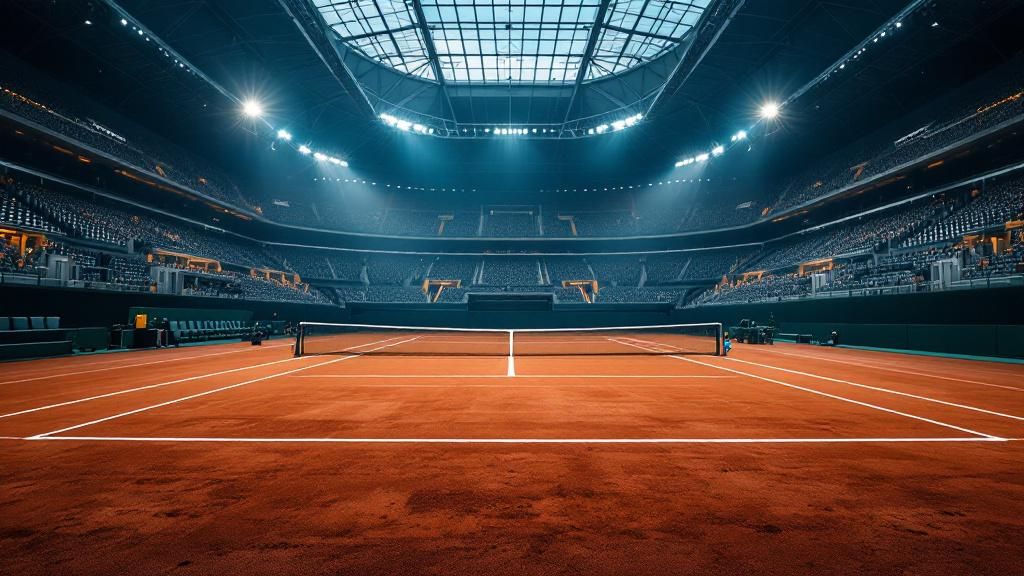
Real Madrid’s iconic Bernabeu stadium will provide a training court for the world’s top-tier tennis players in advance of the Madrid Open in the coming month. The prestigious venue will briefly exchange grass with clay between 23 and 26 April, giving elite competitors including Spanish world’s top-ranked player Carlos Alcaraz an opportunity to perfect their training for one of professional tennis’s major events outside the Grand Slams. The training sessions, which will mirror the clay surfaces utilised at the tournament’s primary location, the Caja Magica, will not be open to the public. The Madrid Open, which spans 20 April to 3 May, combines both the ATP and WTA tours, making it one of the sport’s most prestigious combined events.
A arena adapted for the sport of tennis
The decision to use the Bernabeu represents an forward-thinking solution to a expanding logistical challenge facing the Madrid Open. The tournament’s growth to singles draws featuring 96 players played over a fortnight, combined with the addition of doubles events, has stretched the capacity of the Caja Magica past its workable constraints. By securing access to one of world football’s most iconic stadiums, organisers have managed to cater for the tournament’s ambitious growth whilst preserving the standard of preparation facilities available to the world’s top players.
Tournament director Feliciano Lopez stressed that the move serves a legitimate athletic objective rather than simply operating as a promotional initiative. “The goal is to have a suitable practice facility which helps them – it’s not just a commercial opportunity,” the three-time Wimbledon quarter-finalist said to BBC Sport. Lopez emphasised that after word of the arrangement emerged, he has received numerous enquiries from athletes and coaching staff wanting to access the facility. Real Madrid have no home fixtures scheduled during the week when their recently refurbished stadium will be converted for tennis use.
- Practice sessions open to elite players during 23-26 April
- Court surfaces will accurately match the Caja Magica clay
- Public access to practice sessions will not be permitted
- Tournament matches will take place only at Caja Magica venue
Why Madrid Open needed extra amenities
The Madrid Open has experienced a significant transformation in the past few years, moving away from a conventional event into one of professional tennis’s most forward-thinking and innovative events. The growth to 96-player singles draws contested over a two-week period, paired with the inclusion of comprehensive doubles competitions, has produced extraordinary pressure on existing infrastructure. Tournament organisers found themselves facing a genuine capacity crisis at their traditional home, the Caja Magica, which was unable to accommodate the expanded draw whilst maintaining the rigorous standards required by the top-ranked players and their support staff.
This expansion reflects the tournament’s increasing status and financial attraction within the professional tennis calendar. As one of the most significant events outside the Grand Slam events, the Madrid Open draws the sport’s top players and generates considerable worldwide engagement. However, this achievement produced a paradox: the very popularity that made the tournament so sought-after also pressured its physical resources. Tournament director Feliciano Lopez understood that creative approaches were crucial to preserve the event’s growth path and maintain appeal to top-tier participation from both ATP and WTA participants.
Expanding beyond the initial space
The Caja Magica, located approximately five miles south of central Madrid, has been the Madrid Open’s home for a considerable period. However, the venue’s limitations became more obvious as the tournament expanded its scope and ambition. The facility, whilst adequate for the tournament’s established structure, struggled to provide enough practice facilities and training facilities for the substantially expanded player base now competing in the event. This limitation had the potential to damage the standard of preparation provided for competitors.
By obtaining use of the Bernabeu, organisers have efficiently resolved this logistical puzzle whilst concurrently producing significant marketing value. The celebrated football venue’s adaptation as a tennis facility demonstrates imaginative problem resolution at the most senior operational tier. The arrangement allows the event to preserve its sporting credibility and player satisfaction whilst pursuing its aggressive growth trajectory, guaranteeing the event continues as one of the professional game’s most sought-after and comprehensively supported competitions.
Real Madrid’s athletic aspirations broaden
Real Madrid’s move to create a practice court at the Bernabeu constitutes a strategic expansion of the club’s sports operations outside of football. The 15-time European Cup winners have demonstrated their willingness to embrace forward-looking alliances that boost their legendary venue’s worldwide reputation. By hosting the world’s elite tennis players to one of sport’s most recognisable venues, Real Madrid has established itself as a progressive institution capable of hosting elite tournaments across multiple disciplines. This move supports the club’s wider ambition of the Bernabeu as a versatile sports venue, in the wake of its just-completed transformation that developed it as a modern, world-class stadium.
The plan carries limited interference to Real Madrid’s competitive schedule, as the club has carefully scheduled the court construction to avoid key league matches. Should Real Madrid progress through the quarter-final stage against Bayern Munich, any subsequent matches with Liverpool or Paris St-Germain would be played away from home throughout that timeframe. This careful coordination ensures the football club’s competitive interests remain uncompromised whilst continuing to exploit the business and marketing prospects offered through staging one of tennis’s premier tournaments. The partnership illustrates the way modern sports organisations can utilise their venues and established reputation to enhance their standing within the wider sports landscape.
| Feature | Details |
|---|---|
| Practice court dates | 23–26 April 2026 |
| Tournament dates | 20 April – 3 May 2026 |
| Court surface | Clay, matching Caja Magica specifications |
| Public access | Not open to spectators |
Tournament director Feliciano Lopez has been emphatic that this arrangement represents a authentic athletic programme rather than a superficial marketing exercise. The former world number 13 has attracted substantial engagement from athletes and training personnel keen to utilise the Bernabeu’s training grounds during their competitive build-up. Lopez’s vision emphasises tangible advantage for athletes, guaranteeing the partnership upholds the tournament’s competitive integrity and competitor welfare above all other considerations.
Marketing innovation combines with real-world application
The Madrid Open has firmly positioned itself as a competition keen to challenge boundaries and defy tradition within professional tennis. From introducing an eye-catching clay surface to employing models as ball persons, the tournament has continually aimed to attract worldwide interest through creative ventures. Director Feliciano Lopez has stressed that the organisation takes pride in innovative approaches and taking calculated risks to deliver new experiences for players and spectators alike. This latest venture at the Bernabeu represents the natural evolution of that philosophy, blending the iconic stadium’s worldwide recognition with authentic performance advantages.
Beneath the prestigious surface of hosting matches at one of global tennis’s most renowned venues lies a genuine requirement driving the decision. The Madrid Open’s expansion to 96-competitor singles draws contested over a two-week period, alongside comprehensive doubles competitions, has rapidly outgrown the Caja Magica’s capacity. By utilising the Bernabeu’s expansive facilities for competitor training, organisers tackle genuine logistical constraints whilst simultaneously generating significant promotional value. This two-pronged strategy ensures the partnership delivers substantive benefits to competitors rather than functioning purely as a promotional exercise removed from sporting reality.
- Blue clay surface added to improve the visual presentation and broadcast quality
- Fashion models assigned as ball kids during recent tournament editions
- Virtual tournament conducted during the 2020 pandemic using gaming consoles
- Tournament expansion demands supplementary facilities surpassing Caja Magica capacity
- Practice court installation fulfils player training requirements authentically
Exploring prospects for tennis at the Bernabeu
Whilst the current arrangement concentrates solely on practice facilities, the triumph of this opening partnership could possibly reshape how the Madrid Open runs in future years. Tournament director Lopez has been careful to temper expectations, remarking that hosting tournament matches at the Bernabeu remains outside the organisation’s near-term plans. However, the example established by other major tournaments cannot be completely overlooked. The Miami Open’s addition of a show court within the Hard Rock Stadium shows that such arrangements are viable at elite sporting venues, should conditions and logistics align favourably in subsequent editions.
For now, the emphasis remains firmly on delivering measurable advantages to the world’s leading competitors during the crucial training stage before the main tournament commences at the Caja Magica. The availability of a elite-level practice venue at one of international sport’s most recognisable stadiums provides an unprecedented chance for players to refine their clay-surface techniques. Whether this proves a standalone showcase or the groundwork for a ongoing collaboration will eventually hinge on how well the programme meets player needs whilst maintaining the competition’s profile for innovation and quality.
